Lorenzo ROSA, Andrea CITRINI, Tom TERLOUW, Stefano MINGOLLA (2025)
Rosa et al., 2025
The paper assesses how water scarcity can constrain global ammonia fertilizer production—and how that constraint can cascade through international trade into a systemic risk for global food security. It builds a plant-level inventory of ammonia facilities and quantifies direct (on-site) water consumption, then overlays each site on monthly, ~50-km water-scarcity maps to estimate how much ammonia output (and how many people indirectly supported by that fertilizer) depend on water-stressed locations.
∇ – Methods
A plant-level dataset of 406 ammonia facilities is paired with an LCA accounting framework that distinguishes direct on-site from indirect supply-chain water use; direct process-based coefficients are used to quantify operational consumption by production route, while the scarcity-risk overlay is evaluated on direct water use at the plant location. Monthly water scarcity is mapped on a ~50 km grid as the condition where human water consumption exceeds locally renewable blue-water availability after reserving environmental flows, and plants are flagged as exposed when they fall in scarce cells. Climate-driven scarcity is represented using ISIMIP3b ensembles (5 CMIP6 GCMs × 2 hydrologic models: H08, WaterGAP2-2e) under SSP1-2.6 and SSP5-8.5, holding socioeconomic water-use at 2015 levels and summarizing outcomes over 2020–2029 (2025 representative). Production is then translated into agricultural nitrogen supply (assuming 86% capacity factor and 70% allocation to agriculture), converted into “people fed,” and linked to importing countries through fertilizer trade flows to capture exposure propagated through the supply network.
∇ – Main results
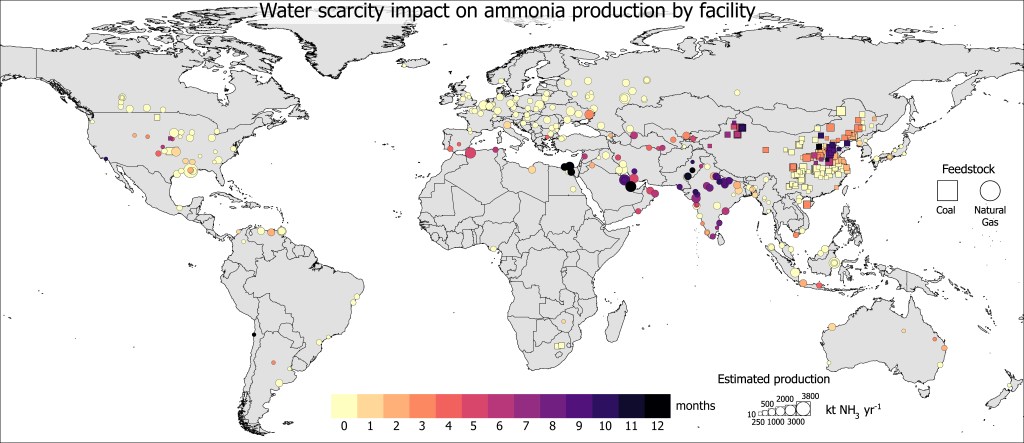
Global direct water use for ammonia production is ~1.09 billion m³/yr, led by China (~342 million m³/yr); coal-based production has higher direct water intensity than gas-based systems. Exposure concentrates in North Africa, the Middle East, and South/Southeast Asia, where some plants fall under scarcity for 6–12 months/year. About 18% of global output sits in water-scarce cells for at least 1 month/year, with the largest exposed volumes in China (~9 Mt/yr) and India (~6.9 Mt/yr) and very high exposed shares in several major exporters. Ammonia-based fertilizers support ~3.8 billion people globally; ~637 million (~18%, range 545–730 million) depend on fertilizer produced under water scarcity. Trade concentrates this risk: China, Russia, Egypt, Saudi Arabia, and Qatar account for over half of the population supported via fertilizer exports, with major links such as China → Brazil and scarcity-linked routes such as Qatar → USA.
∇ – Conclusions
Water scarcity around major ammonia plants is not just a local constraint—it can trigger fertilizer supply shocks that spread through a highly interconnected trade network, creating a system-level vulnerability for food security. The results motivate integrating water availability into decarbonization and industrial planning (e.g., siting choices, water recycling/cooling options, and geographic diversification of supply).
∇ – Resources
Rosa, L., Citrini, A., Terlouw, T., & Mingolla, S. (2025). Water Scarcity Risks in Ammonia Fertilizer Production Pose a Threat to Global Food Security. Environmental Science & Technology, 59(48), 25817-25829.


Leave a Reply