Andrea CITRINI, Bridget R. SCANLON, Ashraf RATEB, Gang ZHAO, Matteo SANGIORGIO, Lorenzo ROSA (2026)
Citrini et al., 2026
The study provides the first global assessment of the potential for Managed Aquifer Recharge (MAR) to mitigate groundwater depletion and reduce unsustainable irrigation. By combining two decades of satellite-derived groundwater observations, high-magnitude river flows, and irrigation water demand, the authors identify where excess surface water could be intentionally stored in depleted aquifers. The framework evaluates MAR potential across global irrigated regions (2002–2021), highlighting areas where recharge could substantially improve water security while maintaining environmental flows.
∇ – Methods
Groundwater depletion was quantified from GRACE/GRACE-FO satellite observations (2002–2021) by isolating groundwater storage anomalies from total water storage using GLDAS land-surface models and global surface-water storage datasets. Long-term trends were estimated with the Theil–Sen estimator after seasonal decomposition.
Potential recharge water was estimated from daily GloFAS v4.0 river discharge, defining high-magnitude flow (HMF) events above the 90th and 95th percentile after reserving environmental flow requirements using the Variable Monthly Flow method. Recharge opportunities were evaluated only from surplus flows remaining after ecosystem needs were satisfied.
MAR feasibility was constrained through a monthly, region-specific coefficient combining infiltration suitability (hydraulic conductivity), evaporative competition, frozen-soil limitations, and off-season cropland availability. Recharge volumes were further capped by cumulative GRACE-derived groundwater depletion, representing the maximum recoverable aquifer storage. Monthly recharge and withdrawal were simulated dynamically to estimate how much unsustainable irrigation could be offset under both HMF scenarios, with additional sensitivity analyses assuming 100%, 50%, and 10% flow-capture efficiencies.
∇ – Main results
Groundwater depletion is widespread across major irrigated regions. The Ganges Basin experienced the largest cumulative groundwater loss (~284 km³), followed by the Sabarmati, Ziya, Lower Yellow, and Indus basins, while several regions in Europe and Southeast Asia exhibited groundwater gains.
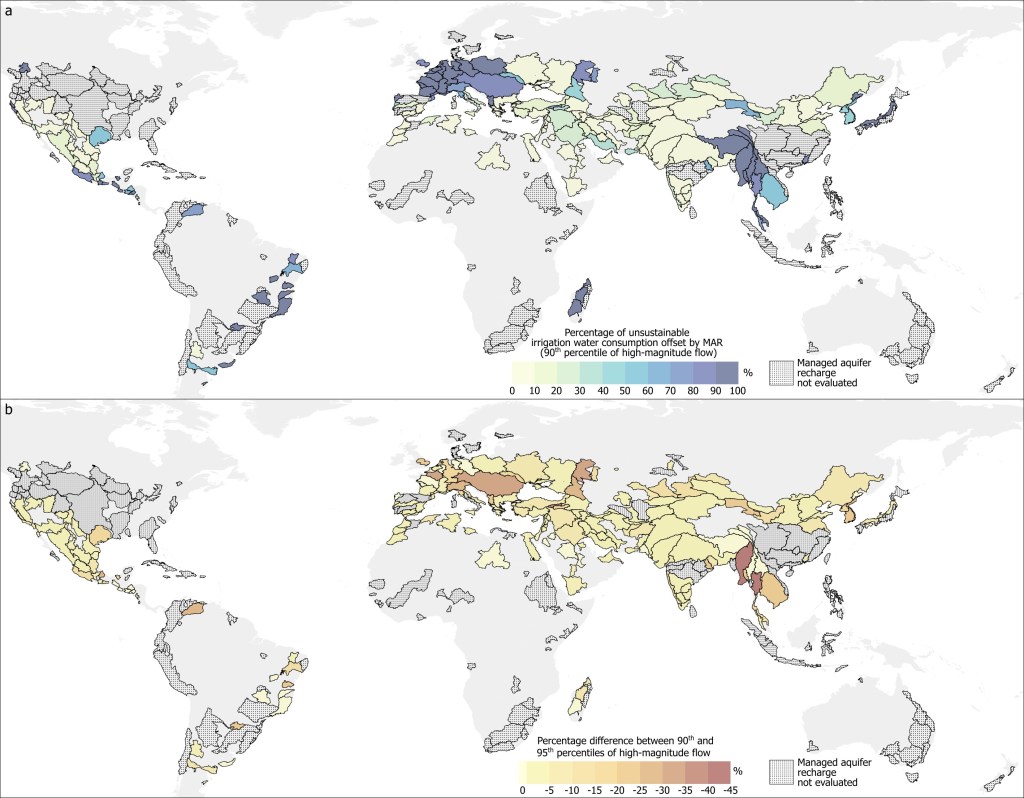
Globally, feasibility-weighted MAR could offset approximately 6% (90th percentile HMF) to 4% (95th percentile HMF) of unsustainable irrigation. Although the global contribution is modest, regional potential is highly heterogeneous. MAR could offset more than 50% of unsustainable irrigation across parts of Central Europe and Southeast Asia, while lower values are found in highly stressed systems such as the Ganges (3–7%), California Central Valley (3–6%), Lower Yellow River (4–7%), and Nile Delta (3–6%) because available floodwater is insufficient relative to irrigation demand. Higher offsets occur in the Upper Yellow River (11–25%) and the Upper and Lower Tigris–Euphrates (15–23%), where depleted aquifer storage coincides with larger high-flow availability.
Sensitivity analyses showed that operational constraints substantially reduce achievable recharge compared with idealized full-capture scenarios, with most irrigation regions behaving similarly to systems capturing ≤10% of available high flows. Interannual analyses also revealed strong temporal variability, emphasizing that successful MAR implementation depends on exploiting episodic flood events through flexible and adaptive recharge infrastructure.
∇ – Conclusions
Managed Aquifer Recharge is not a standalone solution to global groundwater depletion but represents an important complementary adaptation strategy. Its effectiveness is strongly controlled by the coincidence of groundwater depletion, surplus floodwater availability, and local hydrogeological conditions. While global benefits are limited (4–6% reduction in unsustainable irrigation), MAR can substantially alleviate groundwater stress in selected regions and should be integrated with broader water-management strategies, including demand reduction, wastewater reuse, reservoir operation, and improved governance. The study provides a globally consistent framework for identifying priority regions where detailed site-scale MAR assessments should be pursued.
∇ – Resources
Citrini, A., Scanlon, B. R., Rateb, A., Zhao, G., Sangiorgio, M., & Rosa, L. (2026). Global managed aquifer recharge potential as a solution to water scarcity. Nature Water, 1-14.
 ∇ - The Water Table
Leave a comment