Andrea CITRINI, Adriana BRUGGEMAN, Ioannis SOFOKLEOUS, George ZITTIS, Georgia LAZOGLOU, Giovanni Pietro BERETTA, Corrado CAMERA (2025)
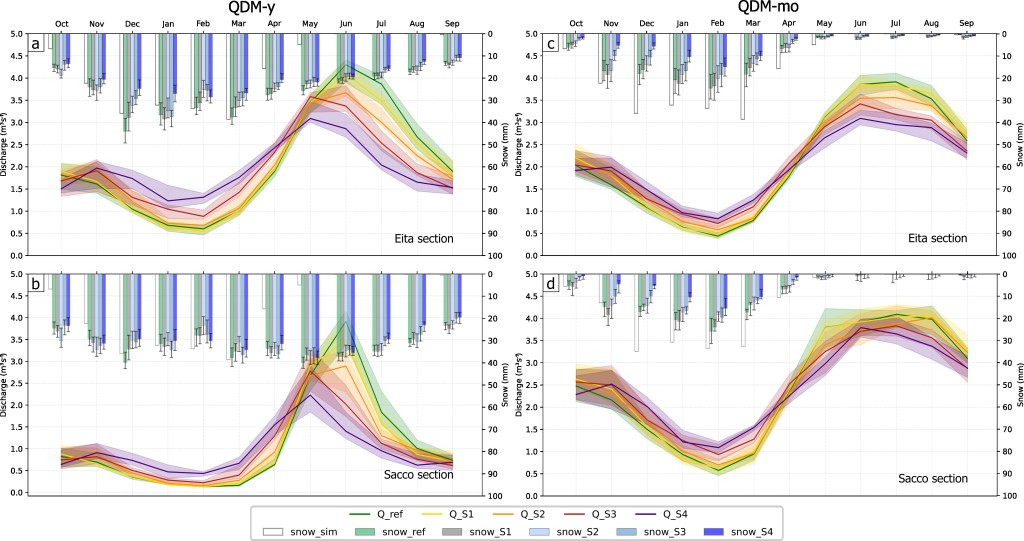
The study assesses how climate change will reshape streamflow regimes and hydropower potential in the Valgrosina Valley (Central Alps, Northern Italy). Two objectives guide the analysis: (i) to quantify streamflow and Gross Hydropower Potential (GHP) shifts under four Global Warming Levels (GWLs: +1.5 °C, +2 °C, +3 °C, +4 °C above pre-industrial baseline), and (ii) to compare two bias-correction implementations of Quantile Delta Mapping (QDM): yearly (QDM-y) vs. monthly (QDM-mo).
∇ – Methods
Daily precipitation and temperature from 21 EURO-CORDEX Regional Climate Models (~12.5 km) were bias-corrected against observations (2005–2020). Bias correction and downscaling applied both QDM-y and QDM-mo. Meteorological forcing included blended radar–gauge precipitation (Radar+OK) and kriged temperature fields. The GEOframe hydrological model, calibrated at Eita and Sacco stream gauges, simulated streamflow and GHP. Model performance and bias-correction accuracy were assessed using ETCCDI climate indices, Kling–Gupta Efficiency, and bias metrics.
∇ – Main Results
QDM-mo outperformed QDM-y, reducing monthly biases in precipitation (−0.4% vs. +14.6%) and temperature (+0.2% vs. +3.3%), and better preserving seasonal coherence. Hydrological simulations revealed consistent winter flow increases (up to +300% or +0.5 m³/s under +4 °C GWL) and summer declines (−19 to −20.5%, around −0.7 m³/s). The seasonal snowmelt peak shifted earlier under QDM-y, while QDM-mo maintained more realistic timing and smoother transitions. GHP projections indicated summer potential losses of up to −20% by +4 °C, with QDM-mo delivering more physically consistent patterns across scenarios.
∇ – Conclusion
Climate change is projected to redistribute runoff in the Valgrosina Valley, amplifying winter flows and reducing summer availability, with direct consequences for hydropower. Monthly bias correction (QDM-mo) provides more robust hydrological projections than the yearly approach, underscoring its relevance for adaptation planning. Adaptive reservoir management and flexible hydropower strategies will be necessary to ensure sustainable energy and water use under warming conditions.
 ∇ - The Water Table
Leave a comment